

How NLP Complements CBT
As mental health professionals, we often rely on trusted, evidence-based approaches to support our clients through anxiety, depression, stress, and life transitions. For many of us, Cognitive Behavioral Therapy (CBT) is one of those foundational tools. It is structured, practical, and backed by decades of research.

But what happens when you want to go deeper—when you want to help clients not only challenge their thoughts, but also shift the internal patterns, language, and emotional states that keep those thoughts in place?
That is where Neuro-Linguistic Programming (NLP) can be a powerful complement.
For therapists—especially those serving diverse communities and navigating the layered realities of culture, identity, and lived experience—integrating modalities can offer more flexibility, creativity, and responsiveness in the therapy room. NLP and CBT are not competing approaches. In many cases, they can work beautifully together.
When used thoughtfully and ethically, CBT provides the structure, while NLP can add depth, language, and experiential change. Together, they can support a more holistic and empowering therapeutic process.
Understanding the Foundation: What CBT Brings to the Table

CBT is one of the most recognized and widely used therapeutic approaches for a reason. At its core, CBT helps clients identify the connection between their thoughts, emotions, and behaviors. It offers a practical framework for recognizing distorted thinking, challenging unhelpful beliefs, and building healthier coping patterns.
For many clients, CBT is effective because it gives them something concrete. It helps them slow down, examine what they are telling themselves, and begin to replace automatic thoughts with more balanced, realistic ones.
CBT is especially helpful because it:
Provides structure and clarity
Helps clients track patterns over time
Supports measurable progress
Offers tools that can be practiced outside of session
For therapists, it also gives us a strong clinical foundation. It is organized, evidence-based, and often easy to explain to clients who want practical strategies.
What NLP Adds to the Process
NLP, or Neuro-Linguistic Programming, focuses on how people experience the world internally—through language, meaning-making, memory, and patterned responses. While CBT often asks, “What are you thinking?” NLP may also ask, “How are you coding that experience in your mind, and how can we shift it?”
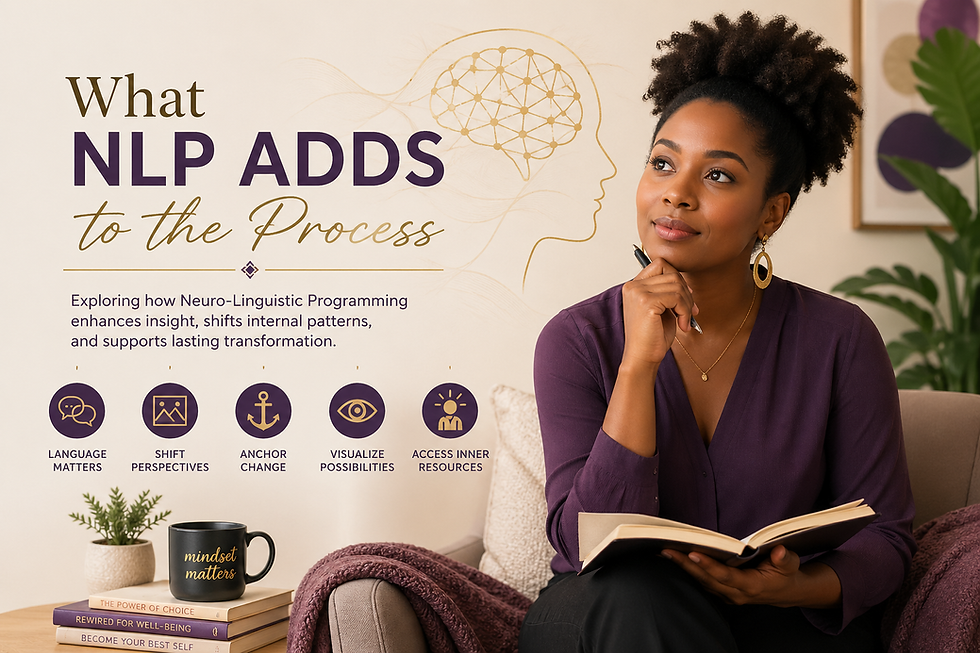
NLP often emphasizes:
Reframing the meaning attached to an experience
Anchoring positive or resourceful emotional states
Visualization and sensory awareness
Language patterns that influence beliefs and identity
Accessing inner resources in a more immediate, experiential way
Where CBT can help a client identify a distorted thought, NLP can sometimes help the client feel the shift more quickly by changing the way the thought is represented internally.
This does not replace clinical reasoning or evidence-based care. Instead, it can offer another pathway—especially for clients who struggle with staying “in their head” or who benefit from more experiential interventions.
Why NLP and CBT Work Well Together
One of the reasons these two approaches can complement each other is because they both recognize a powerful truth: the way we think influences the way we feel and behave.
CBT gives us the framework to assess and challenge maladaptive thoughts. NLP can enhance that work by helping clients shift the emotional and sensory patterns connected to those thoughts.
In simple terms:
CBT helps clients understand the pattern
NLP can help clients interrupt and reshape the pattern
For example, a client may identify a core thought such as: “I’m not good enough.”
Using CBT, we might explore:
The evidence for and against that thought
The cognitive distortions involved
The emotional and behavioral consequences
A healthier replacement thought
Using NLP alongside that, we might also:
Help the client notice how that belief is experienced internally
Reframe the meaning of past events that reinforced the belief
Use language and imagery to create a more empowered internal response
Anchor a felt sense of confidence or calm that the client can access later
The combination can be powerful because it engages both cognitive insight and experiential change.
Practical Ways Therapists Can Integrate NLP with CBT
Blending modalities does not have to mean overcomplicating your work. In fact, some of the most effective integrations are simple, intentional, and clinically grounded.
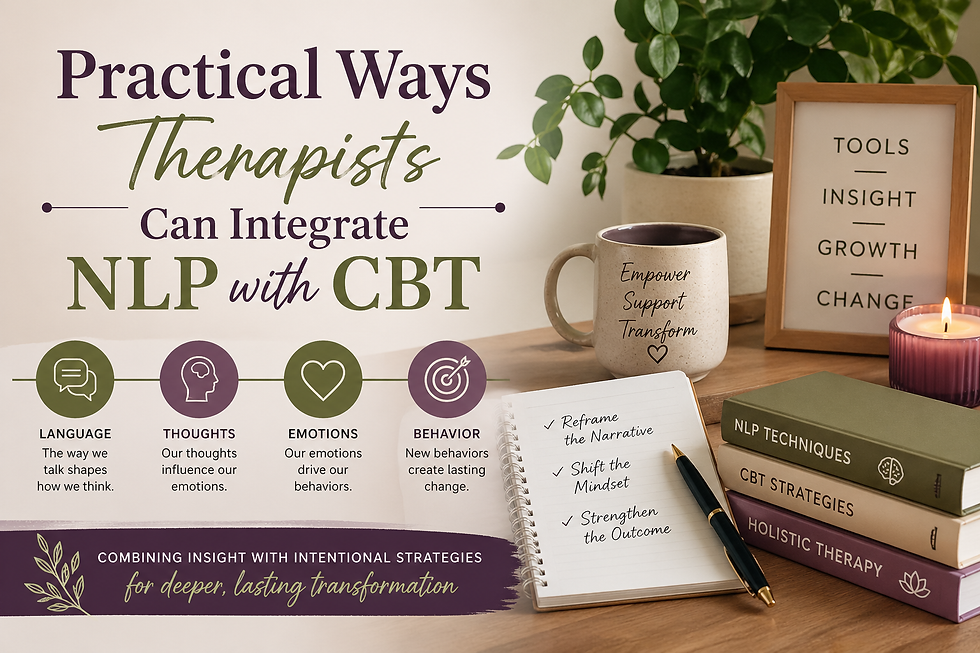
1. Reframing + Cognitive Restructuring
CBT often uses cognitive restructuring to help clients challenge distorted or unhelpful thoughts. NLP can deepen this process through reframing—shifting the meaning of an experience without dismissing its impact.
For example, instead of simply replacing “I failed” with “I made a mistake,” NLP may help the client move toward a more empowering frame such as:“This experience revealed what I needed to learn, not who I am.”
This can be especially useful for clients whose struggles are tied not just to thoughts, but to identity, shame, or long-standing internal narratives.
2. Anchoring + Behavioral Activation
Behavioral activation in CBT encourages clients to engage in activities that improve mood and disrupt depressive cycles. NLP’s anchoring technique can support this by helping clients intentionally link positive emotional states to a physical cue, word, or practice.
For example:
A client identifies a moment when they felt grounded, capable, or at peace
They pair that state with a specific physical action (such as pressing thumb and finger together, placing a hand over the heart, or taking a grounding breath)
Over time, that cue becomes associated with the desired state
This can be particularly helpful for clients who need support accessing calm, confidence, or emotional regulation in real time.
3. Visualization + Exposure Preparation
For clients dealing with anxiety, avoidance, or fear-based responses, CBT often uses gradual exposure and coping strategies. NLP-informed visualization can help prepare clients for that work by allowing them to mentally rehearse success before engaging in the real-life task.
This might include:
Imagining themselves moving through a difficult situation with calm
Rehearsing assertive communication
Visualizing emotional steadiness before a challenging conversation
Practicing a future-oriented success image that supports motivation
This can reduce anticipatory anxiety and increase a client’s sense of internal readiness
Why This Matters for Culturally Responsive Care
For African American clients—and for the African American women who often carry both professional and personal caregiving roles—therapy cannot always be reduced to symptom checklists alone. While evidence-based care matters deeply, many clients also need approaches that honor:
Identity
Story
Survival patterns
Intergenerational messages
Cultural language
Faith and spirituality
The emotional weight of being “strong” for everyone else
This is where an integrative lens can be especially meaningful.
CBT offers structure, clarity, and practical tools. NLP can offer a more flexible, language-centered, and experiential way of helping clients reconnect with possibility, agency, and internal resources.
For many therapists working in Black communities, the ability to incorporate affirming language, narrative shifts, empowering metaphors, and strengths-based reframing can help create a more resonant therapeutic experience.
That does not mean abandoning evidence. It means expanding how we apply it—with sensitivity, creativity, and cultural awareness.
A Valuable Expansion for the Therapist’s Toolkit
For mental health professionals, learning how NLP complements CBT is not just about improving client outcomes—it can also support your own growth as a clinician.

As therapists, we are constantly balancing structure with intuition, science with presence, and protocol with human connection. Integrating approaches thoughtfully allows us to:
Expand our clinical flexibility
Stay engaged and creative in our work
Meet clients where they are
Offer deeper, more personalized interventions
Reflect on our own internal patterns and self-care practices
And if we are honest, many mental health professionals need this reminder too: we deserve tools that support us, not just our clients.
The same reframing, grounding, and intentional mindset work that benefits the people we serve can also help us protect our own well-being, reduce burnout, and stay connected to purpose.
Final Thoughts: Structure Meets Transformation
CBT remains one of the most trusted and practical approaches in mental health care. Its structure, clarity, and evidence base make it a cornerstone for many clinicians. But when paired with thoughtful NLP-informed techniques, it can become even more dynamic.
CBT helps clients understand their patterns. NLP can help them shift those patterns in a more embodied, immediate, and empowering way.
For therapists who value both clinical excellence and holistic care, this integration offers a meaningful bridge between the science of change and the lived experience of healing.
If you are a mental health professional looking for ways to deepen your therapeutic work while honoring the complexity of the clients you serve, exploring how NLP complements CBT may be a powerful next step.
At Mending Minds Counseling and Coaching Group, we believe mental health professionals deserve a safe, culturally responsive, and holistic space to grow—personally and professionally. Because when the healer is supported, everyone benefits.


Comments